
Roman Chester: a visitor’s guide to Deva Victrix
Two thousand years ago the Twentieth Legion held a fortress on the River Dee. Its walls, its arena and a goddess carved in a quarry are still here in Chester, Cheshire, if you know where to look.
Was Chester a Roman city?
Yes. Chester, in Cheshire, began as Deva, a Roman legionary fortress built in the mid-70s AD on a sandstone ridge above the River Dee. From the late 80s it was the base of the Twentieth Legion, Valeria Victrix, for around three centuries.
Deva was the largest fortress of its day in Britain, and its outline still shapes the city: the four main streets meet at the Cross, near the heart of the Roman plan, and the north and east walls follow the Roman line. The Roman name, the full story and a map of the fortress are all in this guide.
What you can see today
- IThe Roman amphitheatreFree, daylight hours. Allow 30 to 45 minutes.
- IIThe Roman north wall and the walls walkFree. The full two-mile circuit takes about an hour.
- IIIThe Roman GardensFree. Columns, carved stone and a rebuilt hypocaust.
- IVThe Grosvenor MuseumFree, suggested donation. Roman tombstones from the walls.
- VMinerva's ShrineFree. A Roman goddess in a quarry face across the Dee.
- VIThe Deva Roman ExperiencePaid. A rebuilt Roman street, good for children.
A fortress on the Dee

Why here
The Romans chose a low sandstone ridge where the Dee could be crossed and where ships could come up from the sea to a natural harbour. From here an army could watch north Wales and the roads to the north of England.

Built in the mid-70s AD
The Second Legion, Adiutrix, began the fortress in the mid-70s AD. Lead water pipes stamped with the name of the emperor Vespasian help to date the first buildings.
The first defences were earth and timber. From around AD 100 the Twentieth Legion began rebuilding them in red sandstone, a job that took generations.

Bigger than it needed to be
At around 25 hectares, Deva was the largest fortress built in Britain in the 70s, and one building inside it, the oval Elliptical Building, has no known parallel in the Roman empire. Some historians think Chester was meant to become a governor’s headquarters; others think the extra room was simply for a larger garrison. Nobody knows for sure.

Three centuries of the Twentieth
The Twentieth Legion, Valeria Victrix, arrived from Scotland in about AD 88, when the Second Adiutrix was sent to the Danube. Detachments went north to help build Hadrian’s Wall in the 120s, and the army had gone by about 410. To the Anglo-Saxons, Chester was the city of the legions.

The men on the walls
A legion of the period had around 5,000 heavily armed citizen soldiers. Their tombstones, built into the north wall centuries later and found again in the 1880s, are in the Grosvenor Museum today.
A legionary’s kit, around AD 100


Britain’s largest known Roman amphitheatre
Built just outside the fortress in the late 1st century, it may have held between 7,000 and 12,000 people. Soldiers trained here as well as watching the shows.


About two-fifths of the oval is uncovered today; the rest lies under the buildings beside it. A small shrine to Nemesis, goddess of fate, opened off the arena itself, and it was rebuilt when the amphitheatre came back into use around AD 275.
It is free to walk round, every day in daylight, five minutes from the Eastgate clock.
Find the fortress under the city
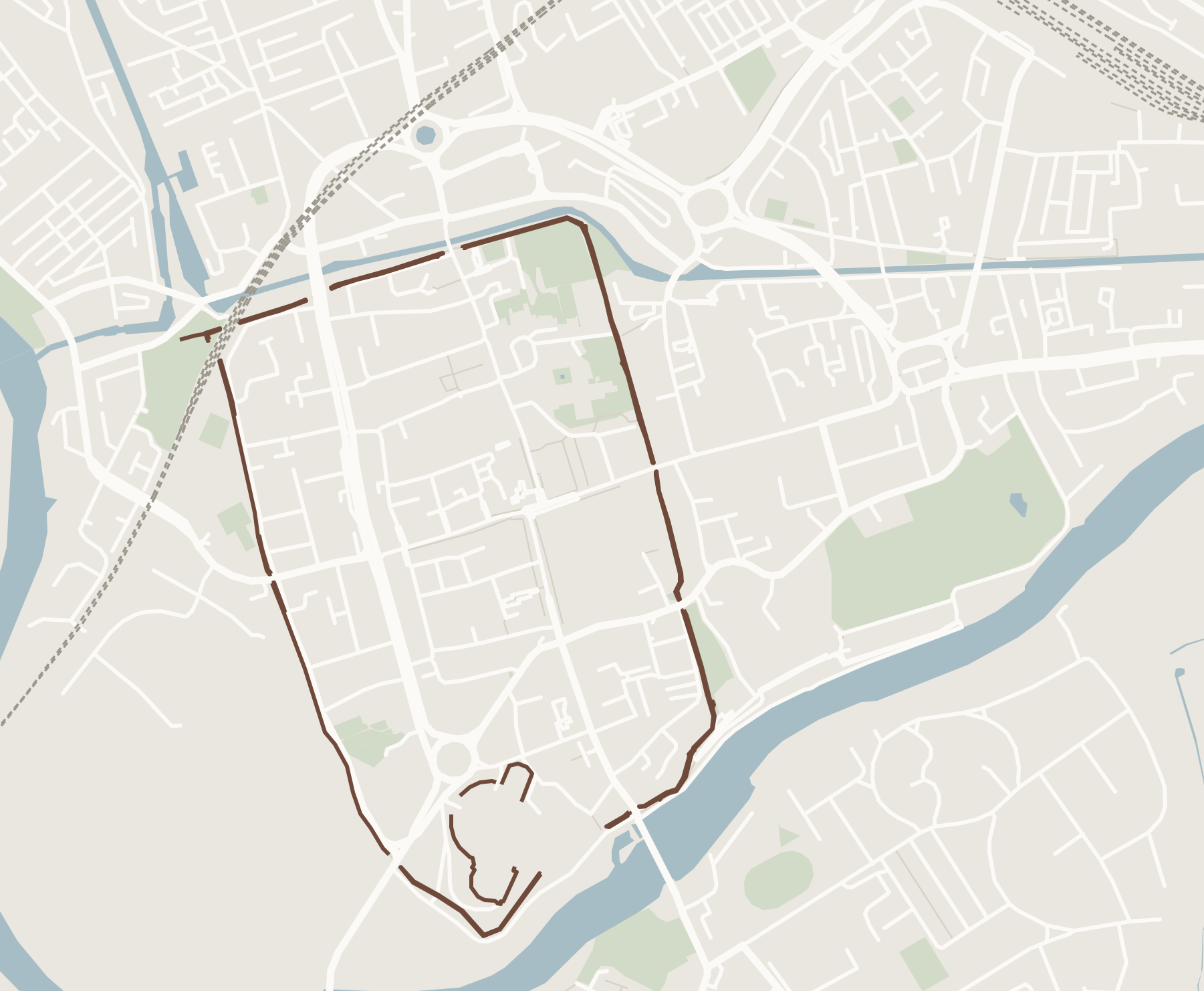
The Roman fortress over today’s streets, with everything you can still see. Choose a marker to find out what is there.
Roman, still visible · free
Roman amphitheatre
Built just outside the fortress's south-east corner in the late 1st century. About two-fifths of the oval is uncovered; the rest lies under the buildings and Dee House beside it. Free and open daily in daylight.
- Roman, still visible
- Roman finds on show
- Under today's streets
- Rebuilt from Roman stones
- Roman fortress (approximate line)
- Today’s city walls

Are Chester’s walls Roman?
Partly. The north and east walls follow the line the Romans laid out, and near Northgate the Roman wall still stands close to its full height.
Between Northgate and King Charles’ Tower, two stretches of the Roman wall survive with up to 13 courses of Roman stone and a moulded cornice along the top. The best view is from the canal towpath below.
The rest of the two-mile circuit, the most complete in Britain, was extended by the Saxons and the Normans and repaired ever since.


Life outside the gates
A town grew up around the fortress: shops along the roads, workshops, taverns and the houses of soldiers’ families and veterans who settled here.


Three ways to spend a Roman day
Two hours
The amphitheatre, the Roman Gardens next door, then up onto the walls at Newgate and round to the Roman stretch by Northgate.
Half a day
Add the Roman tombstones in the Grosvenor Museum and a walk over the Old Dee Bridge to Minerva's Shrine in Edgar's Field.
A full day
Add the Deva Roman Experience, the full two-mile walls circuit and, if it's running, a tour with a costumed Roman soldier.
Questions people ask
Was Chester a Roman city?
Yes. Chester began as Deva, a Roman legionary fortress founded in the mid-70s AD above the River Dee. The Twentieth Legion was based there for around three centuries, and the fortress plan still shapes the city centre.
What was Chester called in Roman times?
Deva, after the River Dee. The legionary fortress is often called Deva Victrix, the second word taken from the title of the Twentieth Legion, Valeria Victrix. The name Chester comes from the Latin castra, a fort.
Is the Roman amphitheatre in Chester free?
Yes. The amphitheatre on Little St John Street (CH1 1RE) is free to visit and open every day in daylight hours.
Are Chester's walls Roman?
Partly. The north and east walls follow the line of the Roman fortress, and stretches of Roman wall survive near Northgate. Most of the two-mile circuit you walk today is Saxon, medieval and later work.
How long do you need to see Roman Chester?
Two hours covers the amphitheatre, the Roman Gardens and the Roman stretch of the walls. A full day adds the Grosvenor Museum, Minerva's Shrine and the Deva Roman Experience.

The Dee still runs below the walls.